Sunday, February 13, 2011

Will There Be A Looping In This Current Rally?

Remember the double dip talk about a half a year ago? This was at a time when people did not believe in the recovery, and started to sell equities again.The FED´s quick reaction with money printing, "aka QE2", helped the market not only to regain confidence, but as Fred Hickey notes in his February Report, helped to jumpstart the return of a stock market mania that was reminiscent of 1999. He further notes:

“Relentlessly rising stock prices, extremely unattractive alternatives (zero percent interest rates with inflation rising – a negative real rate environment) and the knowledge that Big Ben, with his virtually unlimited money printing capability and his desire to see stock prices rise, are the ingredients encouraging the return of wild stock market speculation.”

Hickey also sounded the alarm bells for technology stock investors who are buying high PE multiple stocks such as VM Ware, Amazon, Salesforce.com and Netsuite.

"Once again, the risks of steep losses are high. Tech stocks are currently levitating on the assumption of a continuous flow of Fed juice. If that supply is interrupted for any reason (high inflation, the need to defend a plunging US dollar, etc) then heaven help the retail investor being lured into overpriced tech stocks today."

Even though I have to agree with the above, it was Mr. Hickey who said the following at the Barron´s Roundtable:

"I wouldn't short stocks, particularly tech stocks, in a money-printing environment." When there is tremendous liquidity coming into the market, investors seem to gravitate toward tech and they lose all concept of valuation. These stocks will get crazier. I am worried the tech sector is going to have another collapse, as it did in 2007-08 and 2000 to 2002."

But Mr. Hickey also noted:

"Google isn't a bad play, but there is some danger in all this spending. Given that, I am recommending Microsoft again this year. It is the cheapest of all."

Buying the cheapest could turn out to be a bad decision, when it comes up to MSFT and GOOG. If the later starts to rise again next week, it is a clear sign that the market starts to reward something Mr. Hickey does not see at this point in time. Mr. Hickey has all my respect for his work his has done, but maybe he will come out with a sudden change of mind this year, when it comes to GOOG.

Last week Microsoft decided to team up with Nokia, but this new alliance has been punished by the markets. Google, on the other hand, rose to USD 624.5, challenging once again break out territory.

GOOG: If momentum picks up, we have to add.

MSFT: Breaking support, money flowing into GOOG?

The rise in equities last week has once again seen very low volumes and Indices look more and more vulnerable to correct some of the recent gains. Momentum does not confirm the new highs set by the Stock Market Indices last week. But for now, there are no clear signs of a top.

SPY: Heading towards resistance at 133.84

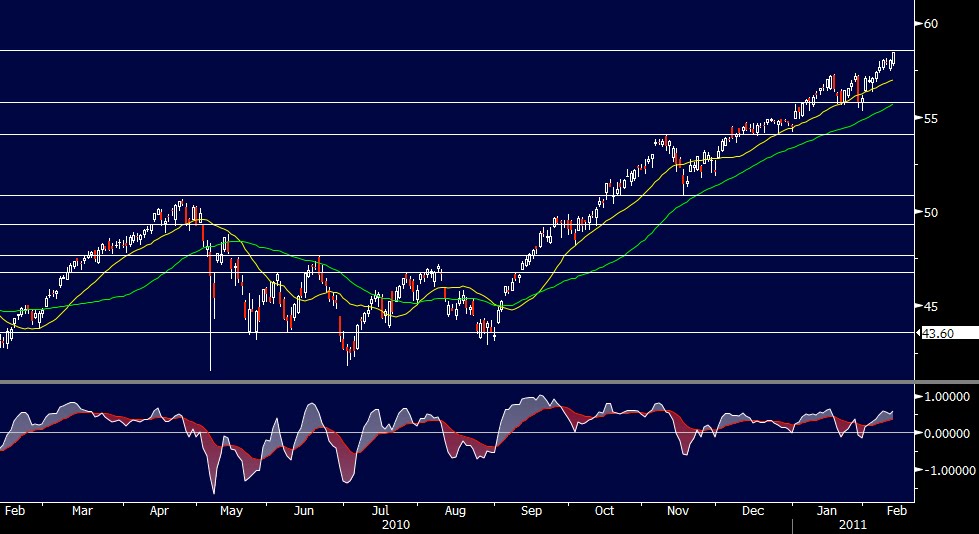
QQQQ: Challenging resistance at 58.56

S&P100: Momentum looks worse than ahead of the flash crash

NYSE: Don´t like the momentum indicator here; stalling at resistance.

Dow Jones Industrial: "In best technical healthy condition..."

Eurostoxx: Struggling with resistance; momentum divergence

DAX: Break out more successful here, next resistance 7500

SMI: Break out at 6700, but not much upside potential.

Crude: Make or break situation here...


SDF: Still struggling with 58, but momentum is impressive.

SYNN: Break out after Q4 result and announcement of restructuring.


USD: Working on a bottom, but still a fragile plant...

USD P&F

EUR P&F

EURCHF P&F: "The Urs Schwarzenbach break-out"

USDCHF: Heading towards parity, wait for the break out


Wednesday, February 9, 2011

Trading The SPY Ahead Of FED Talk

The chart below displays the 60' price structure of the S&P ETF SPY. We are trading right now at 132.06 in pre-market, just below the steep uptrend of this rising wedge.

So it looks like the buying pressure is over, and we have to wait for the Grill Session on Capitol Hill with Ben Bernanke and of course, the Fed Vice President Brian Sack who speaks on "Implementing the Federal Reserve’s Asset Purchase Program" (aka QE2) at the Philadelphia Fed, but the later will be after EU close.

I expect a change in the wording like previously on the MBS repurchase program but not on the FED funds, where the bottom line is that the core measures of inflation are still very low, and it is very unlikely that the Fed will raise the Fed funds rates this year. Of course, this is the same mistake like in 2005, when the FED started to raise rates much to late, in 2005 when the Dow Jones broke 11000. This time, the FED will probably not raise rates unless the Dow crosses 14000.

The FED could sound like this, which it did in previous asset purchase programs:
To promote a smooth transition in markets as these purchases of Treasury securities are completed, the Committee has decided to gradually slow the pace of these transactions and anticipates that the full amount will be purchased by the end of....
or
Committee will gradually slow the pace of these purchases in order to promote a smooth transition in markets and anticipates that they will be executed by the end of the first....
I believe that the recent break out to the upside have brought one common sense to traders: The only way is up and I am very smart.


Sunday, February 6, 2011

Signs Of Distribution

The past week of trading has been marked by strong sector rotations that have kept equity markets in their steep uptrends. The VIX Index, measuring market volatiltiy, has once again fallen to it's lowest levels of the year, indicating complacency among investors. Comparing the acutal VIX level to sentiment cycles, I belive that we could soon hit the "wow I am smart levels". The AAII Bullish sentiment indicator is once again on the rise, indicating broad bullishness among investors. The same goes for the Euro which has seen the biggest rise in speculative long positions for a long time.


For now, we have some divergences worth looking at, that are building up in the US equtiy market: The Dow Transportation Index is not confirming the new highs set in the Dow Jones Industrial. The Russell 2000 (small cap sector) starts to lag big caps (S&P100). The Cumulative AD is just flattening a little bit in the NYSE, the S&P AD line managed to make a new high, confirming the last weeks rise in the market. The strong sector rotations, as well as the change in leadership could be an early indication that markets could get closer to an intermediate top. Probably too early to sell, and too late to buy...The USD remains weak, but sentiment is getting extremly bearish. As the chart above shows, speculative long positions in the EUR have risen to the highest levels of the year, where as those for the USD turned negative on the year. I remain positive on the USD at the current levels. A break of 78.5 in the DXY would be a first step in the right direction...


As you can see from the charts below, equity markets are clearly breaking to the uspide, with most of the Indices trading above important resistance levels. This is a good reason for a positive start for the new week.

Eurobanks still chalenging the downtrend, no short yet.


DAX: Trading above 7200, next resistance is 7500


Eurostoxx: Trading above 3000, next resistance is around 3100

Dow Jones breaking 12035, next resistance around 12335

QQQQ: Next resistance around 58.50

SYNN: Waiting for numbers, still in break out territory

SDF: What an amazing rebound, 58 is next resistance


Egypt has brought some focus on Energy Stocks, we are buyers here.

Uranium Participation

Cameco


ATLN: Wait for a break of 55 to add more.. speculative position

Bayer: Long at 54.5, does not want to break down, stopp loss 53.5


Emerging markest still a sell:


Sunday, January 30, 2011

There Is Nothing More Frightening Than Ignorance In Action


I found this sentence in Satyajit Das´s Blog - Fear & Loathing in Financial Products, and as the author says, an observation made by Goethe. It goes on:

On 30 July 1998, Alan Greenspan, then Chairman of the Federal Reserve argued that: “Regulation of derivatives transactions that are privately negotiated by professionals is unnecessary.” In October 2008, the now former Chairman grudgingly acknowledged that he was “partially” wrong to oppose regulation of credit default swaps (“CDS”). “Credit default swaps, I think, we have serious problems associated with them,” he admitted to a Congressional hearing. His current views on wider derivative regulation remain unknown. Politicians and regulators globally are currently busy drafting laws to regulate derivatives. A common theme underlying the activity is an absence of knowledge of the true operation of the industry and the matters that need to be addressed.

In DAVOS, at the yearly reunion for overrated Million- & Billionaires, surrounded by exactly those politicians, the common sense was that the economy is improving - and listening to Joe Ackermann from Deutsche Bank, one could think that the actual recovery is unstoppable. "Growth in emerging Markets remains strong", he says and as Greece gets downgraded to junk, he continues: "There is no way that Greece or Spain are going to default." Meanwhile, a solid framework for regulations on investment banking- and derivative transactions is not in sight. As the author Thomas Pynchon warned:

“If they can get you to ask the wrong questions then the answers don’t matter.” Simplistic causes and solutions may prevent real issues in relation to derivatives from being debated and dealt with."

The Obama Administration’s proposed “Volcker Rule” prohibiting major banks engaging in proprietary trading may, if implemented, affect speculative activity in derivatives. The proposal would prevent banks from hedging their own exposures using swaps as well as trading swaps. At a minimum, it would force banks to move their derivatives activities into non-bank entities. Transferring such activities would require additional capital (estimated at $20 billion or more) and also result in higher cost of funding for the derivatives activities. It is not clear how this proposal actually addresses any of the fundamental issues relating to derivative activities.


Hedging Activity?
The last week has ended with a sell-off that hit equity markets across the world. The main reason, market observer say, were the mounting tensions in Egypt. So is there fear in the market? Looking at hedging activity, the US CBOE Volatility Index Point & Figure chart is a helpful tool. The Index has made a quadruple bottom break down, a very strong sell signal but now the Index reverses this sell signal as it did a this very same level in spring 2010. So last week we have just seen a small reversal pattern that has not given buy signal yet. A break of the downtrend, indicated by the white line, would be a clear indication that equity markets are running into trouble and could head for a bigger downside move. But for now, it does not look as if investors are worried. In fact, the level indicates complacency.

Focusing on the rally in commodities and equities that has started beginning of september 2010, we have to admit that some trends are broken and some could break soon. If markets are heading for a bigger correction can not be confirmed, nor ruled out at this point in time. I still view the biggest threat for financial market coming from the EUR and China, where as the US is certainly out of the woods for the next 6 month, probably the outperforming market until summer.

SPY 60´: Trend still up, but "break out profits" are gone.

QQQQ 60´: Trend break & a retest, starts to look topish.

Eurostoxx: Failed at resistance but still above trend channel.

SMI: The break out of this triangle is a bad sign short below 6400

DAX: 7000 becoming an important level. No trend break or double top?

EURUSD: Overshooting and a strong sell here. Probably interventions.

USD: Working on a bottom, not much downside from here

Gold: Will not buy until USD 1256

Crude Oil: Looks like the beginning of a top

GOOG: Gave a sell signal but would buy around USD580

SYNN: Still no break out

SDF: Could fall below 50 short term if 53 does not hold

NESN: Is something to watch below 50

European Banks: If there is no break- out I would short below 18

Bayer: Short Candidate in the DAX. Broke 54, giving a sell signal.

Shanghai Composite: Somebody´s buying but does not look good

Brazil: Fighting with the last support

India: Under heavy selling pressure